
The right quality standard for your project
We adhere to the highest standards throughout our entire production process and deliver your products to the chosen quality.
Organisation according to the standard of Tilkin Powder Coatings NV
For an outdoor setup, we first determine the setup area and then discuss a "Corrosivity Class" C1, C2, C3, C4, C5/I, C5/M. This coding also exists for an indoor setup, depending on the ambient air to which the product is exposed.
Below you can see the map of the Benelux next to the window where the different classes are coloured in.

If the quality and location of the product setup match, you will receive a 10-year warranty. If you choose a lower quality in a very aggressive sea climate, your warranty will immediately expire! With a higher quality in a rural area, you even get a 15-year warranty on your steel structures! It is therefore very important that the customer informs us correctly so that we can apply the right treatment to the structure.
Corrosivity class
Class C1
- Indoors: heated buildings with a clean indoor climate. For example: offices, shops, schools, hotels, …
- Outdoors: not applicable
Class C2
- Indoors: light condensation, unheated buildings where condensation may occur, storage areas, sports halls, ...
- Outdoors: low humidity, atmosphere with a low pollution level, dry area with little air pollution, agricultural areas, rural environments
Class C3
- Indoors: high humidity, workspaces with high humidity and some air pollution, laundries, breweries, dairies, …
- Outdoors: high humidity, moderate pollution, urban and industrial atmospheres with moderate CO2 pollution, coastal areas with low salt levels
Class C4
- Indoors: high humidity, moderate pollution, chemical plants, swimming pools, ports, shipyards, …
- Outdoors: industrial areas, areas close to the coast, areas with high humidity and aggressive atmosphere and chemical constructions with constant moisture and dirt load
Class C5/I
- Indoors: areas and buildings with almost permanent condensation and a very high pollution level
- Outdoors: high humidity, aggressive atmosphere, industrial areas
Class C5/M
- Indoors: areas and buildings with almost permanent condensation and a very high pollution level
- Outdoors: coastal areas, areas with an aggressive atmosphere with high salt concentrations, offshore areas, offshore wind turbines, drilling rigs, …
Shine
Our blasting machine and cabins meet all standards.
The operational mixes of the different blasting media are checked weekly by us by performing a sieve analysis test. If necessary, the installation is better adjusted so that the operational mix remains optimal to maintain the result of cleanliness and roughness during blasting.

The operational mix is maintained by us by connecting each blasting kettle with the unique PLC system that records the working hours of each blasting kettle and thus indicates the specific times to refill new material with a certain quantity.

The surface roughness is checked daily by us (see image).

The cleanliness of the substrate is described according to the Swedish blasting standard ranging from Sa1, Sa2, Sa2 ½, and Sa3. If the substrate is intended for metallisation, Tilkin Powder Coatings maintains at least the standard Sa2 ½.

Metallising
The construction is first checked for its cleanliness and roughness after blasting.
The layer thicknesses after metallisation are systematically checked by our operators for each project. The layer thickness is determined by the use and the environment where the construction will be located. The layer thickness in a non-maritime environment varies between 40 and 60 microns (ZN50 is the standard specification). If it is a maritime environment, the layer thickness varies between 80 and 120 microns (ZN100 is the standard specification).
Our guarantee
You can assume that at Tilkin Powder Coatings, the correct standards and values for people, nature, and products are respected. The necessary expertise is present so that the proposed guarantees can be ensured without any problems!
Powder coating
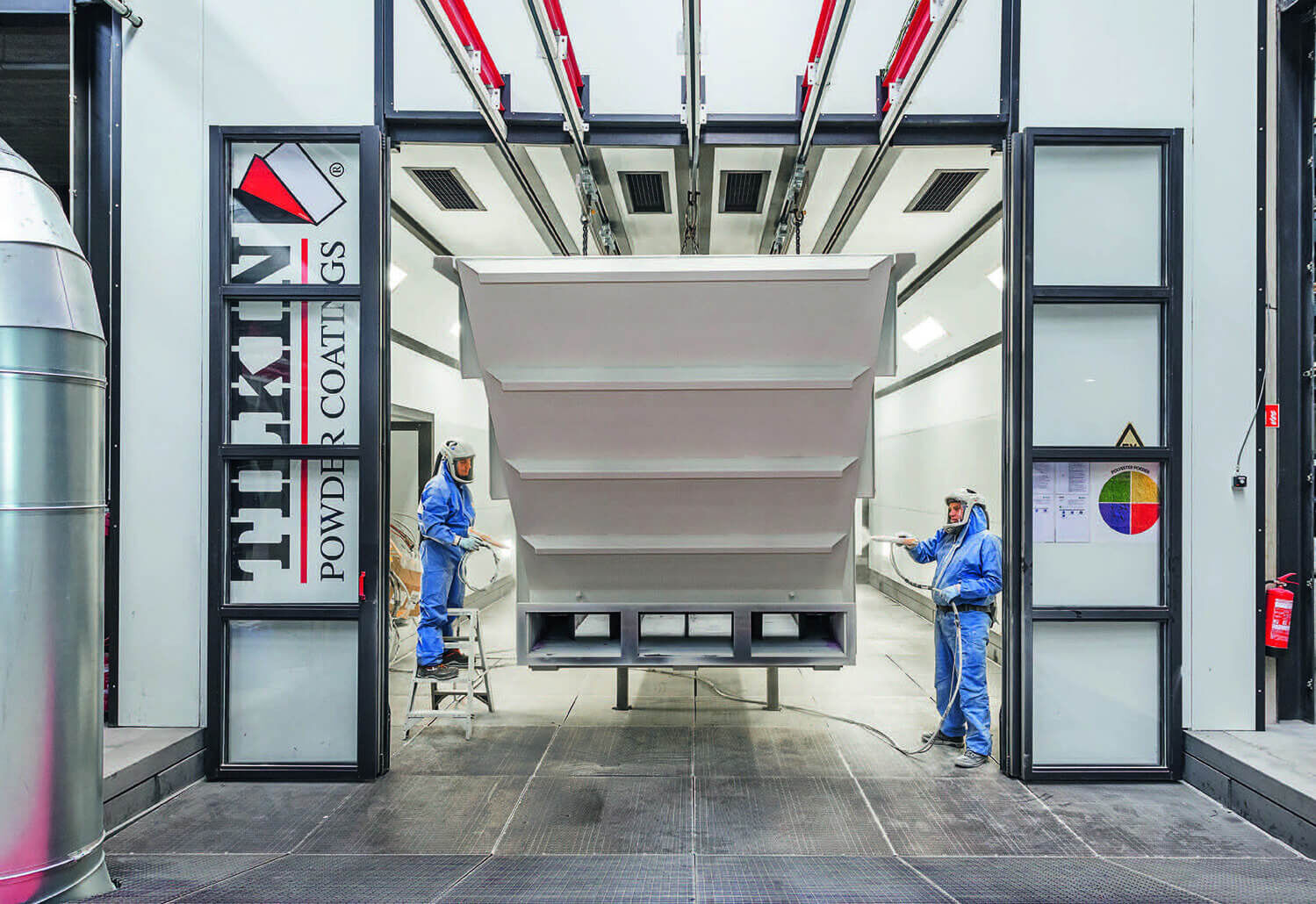
Before powder coating can begin, the construction will be checked for cleanliness, roughness, and possible layer thickness of the metallisation process.
After inspection, the construction will be lightly sanded so that the peaks after blasting or metallisation are flattened. Subsequently, the construction will be completely dedusted by projecting compressed air onto the substrate.

The operator will first scan the order into the advanced ERP system, then the operator will see the correct colour code and any alerts on their screen. The operator cannot use a different colour code than the one provided during the creation of the order, as the box of powder must first be scanned so that the system can compare the codes.


The layer thicknesses of powder coating are checked by our operators using scanning before it is cured. This ensures that sufficient layer thickness build-up is created in the first instance.

The epoxy primer is used in a two-layer system and serves to guarantee a high visual quality requirement or as extra protection if placed in a marine environment. The layer thickness varies between 40 and 80 microns and is checked again after curing.

Once the primer layer is checked and any irregularities are corrected where necessary, the topcoat will be applied in the same manner including all previous checks. The layer thickness varies between 70 and 110 microns.
Our powder guns are always up-to-date and also linked with our unique PLC control. This means that powder consumption is immediately deducted from the stock so that it always remains correct, and the wear parts of the guns are indicated by our system in a timely manner when they need to be replaced. This way, we always guarantee our renowned top quality!

Moffelen
Baking is the curing of paints and coatings in an oven.
The paints are called thermosetting reaction paints: in the baking oven, the product with the attached powder is brought to a chemical reaction at about 180°C, causing the powder to melt and the powder coating to acquire its final properties.


Where do we make the difference?
Tilkin Powder Coatings distinguishes itself by:
Tilkin Powder Coatings is capable of curing different colours simultaneously with this curing oven without different coloured powder particles swirling around during the heating process.
The temperature and time are automatically calculated and logged by our PLC (Programmable Logic Controller) software, ensuring a built-in check to prove the required baking cycle according to the EN1090 standard!
Final check
After the constructions have been coated and received their final layer, they are visually inspected and the layer thickness is finally measured. From the moment this meets the quality requirements of us and the customer, it can be packaged according to predetermined guidelines.

Did you know?
If local rust formation does occur after the construction has been treated against rust, it is always noticeable within the first 6 months. This rust formation worsens over the years, resulting in a complete renovation being unavoidable after ten years.
If steel is not treated and is exposed to an environmental area C2, steel corrodes at 0.2 mm per year. In this way, this valuable raw material is lost and it greatly harms our nature!