
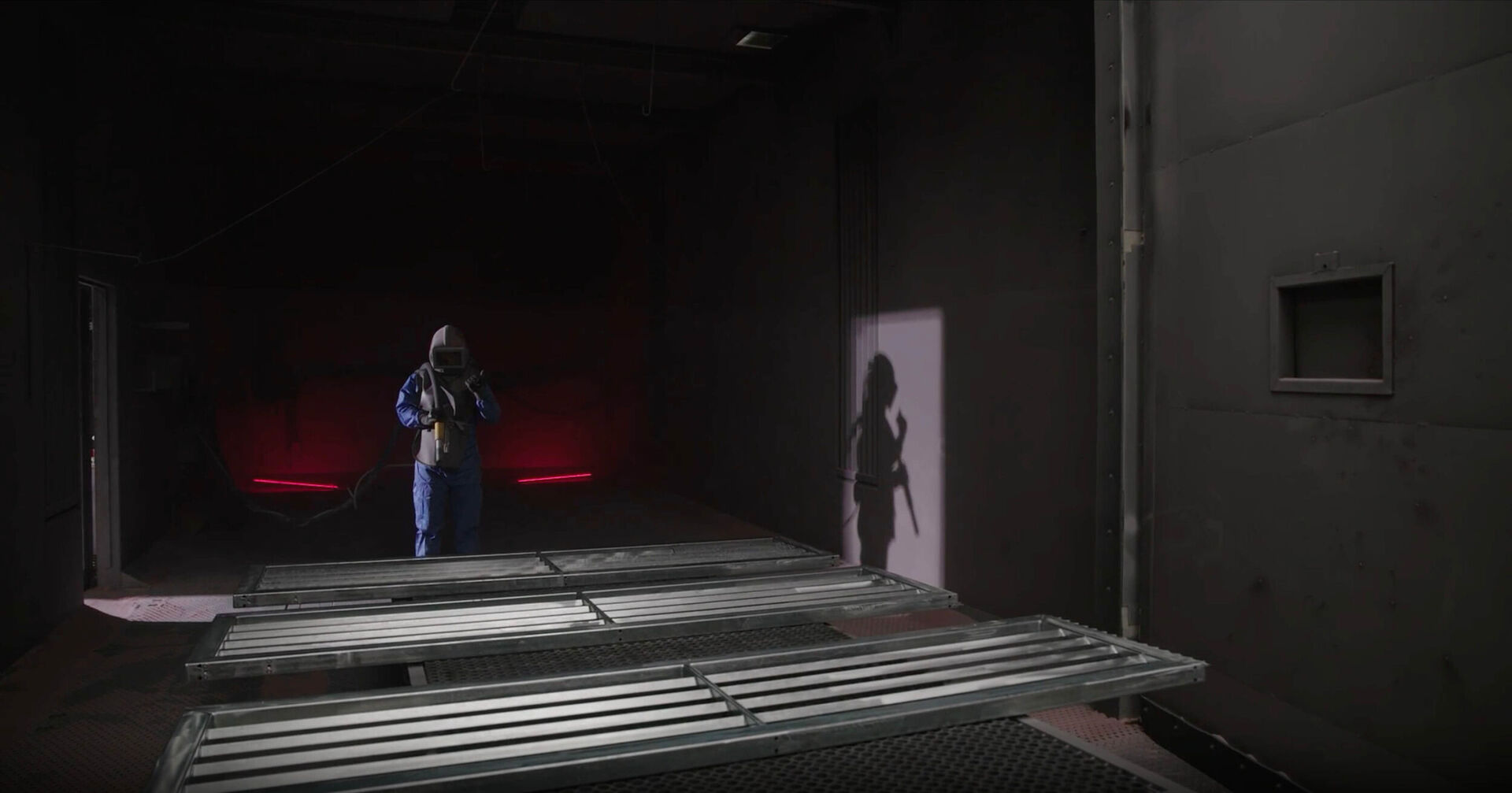
At Tilkin Powder Coatings, every project begins with perfect cleaning and optimal preparation. Our advanced blasting techniques remove rust, mill scale, oil, and old coatings while creating the ideal surface roughness for guaranteed adhesion of both functional and aesthetic coatings.
Our blasting methods:
- Grit blasting: Using stainless steel angular grit, we remove rust, old paint, and varnish layers while creating a rough and clean surface. Ideal for large steel constructions up to 20 meters long, 3.7 meters wide and high, and weighing up to 6 tons.
- Wheel blasting: An electric turbine propels blasting grit at speeds of up to 300 km/h onto the surface. Suitable for heavy metal components up to 18 meters long, 1.8 meters high, and 3 meters wide.
- Grit blasting with Garnet: High-quality Garnet blasting grit with an extremely fine grain size, perfect for constructions made of stainless steel, hot-dip galvanized steel, aluminum, and thin steel body parts. Suitable for constructions up to 9 meters long, 3.7 meters high, and wide.
Chemical Pre-Treatment
For surfaces that are not suitable for blasting, Tilkin Powder Coatings offers chemical cleaning in our spray tunnel using an iron phosphate cleaner. For additional resistance, we apply a passivation layer of zirconium oxide. This method is ideal for smooth metal surfaces that do not require stringent adhesion tests or when blasting is not cost-effective.
Grit Blasting
Grit blasting is a method used to clean and roughen metal objects.
This technique effectively removes rust, old paint, and varnish layers. Using metallic angular grit and a compressor providing sufficient compressed air, the grit particles are blasted at high speed onto the surface, creating the desired surface roughness and cleanliness. The working pressure is typically around 6 bar.
There are many types of metallic blasting grit, but at Tilkin Powder Coatings, we use high-quality stainless steel angular grit with a specific mix of grain sizes. This proprietary mix ensures that after blasting, the surface is rough enough for metallizing, providing GUARANTEED adhesion.
Grit blasting is primarily applied to all steel constructions intended for outdoor use. Our blasting cabin can accommodate constructions with maximum dimensions of 20 meters in length, 3.7 meters in height and width, and a maximum weight of 10 tons.

Sandblasting
Sandblasting is a method used to clean metal or solid wooden objects.
This technique effectively removes rust, old paint, and varnish layers. Using metallic angular grit and a compressor providing sufficient compressed air, the grit particles are blasted at high speed onto the surface, creating the desired surface roughness and cleanliness. The working pressure is typically around 6 bar.
There are many types of metallic blasting grit, but at Tilkin Powder Coatings, we use high-quality stainless steel angular grit with a specific mix of grain sizes. This proprietary mix ensures that after blasting, the surface is rough enough for metallizing, providing GUARANTEED adhesion.

Wheel Blasting with a Wheel Blast Machine Featuring 16 Blast Wheels!
Wheel blasting has the same purpose as grit blasting.
This is also a technique used to clean and roughen metal objects and, if necessary, to remove rust and old paint or varnish layers. In wheel blasting, compressed air is NOT used to accelerate the blasting grit, but instead, an electrically driven blast wheel or turbine is used. The speed at which the abrasive leaves the blast wheel is approximately 300 km/h. The amount of abrasive required is about 6 tons per minute. The cleaned and reusable blasting grit is automatically collected in the storage bunker and redistributed across the 16 blast wheels. This wheel blasting machine can handle constructions with maximum dimensions of 18 meters long, 1.8 meters high and wide, and a maximum weight of 10 tons.
The working principle of wheel blasting is as follows:
A controlled amount of abrasive flows from a storage bunker to a blast wheel (turbine). In the center of the blast wheel, there is a pre-accelerator (impeller), which provides the first acceleration of the abrasive. Through a bus with an opening (the distributor), the abrasive reaches the correct position on the blades of the blast wheel. These blades (vanes) further increase the ejection speed. Due to the high centrifugal force, the abrasive leaves the blast wheel at a precisely determined moment and impacts the object to be blasted.
Wheel blasting can be applied to all steel constructions for both outdoor and indoor use, whether or not they need to be metallized afterward, such as fences, railings, semi-trailer chassis, profiles, beams, 3D tubular frames, stairs, thick-walled plates (from 6 mm), ...

Where do we make the difference?
Tilkin Powder Coatings sets itself apart through:
- The extra environmental measures we take: all electric motors meet the IE3 class standard. High-efficiency motors are controlled via frequency regulation to prevent power surges and reduce CO₂ emissions.
- The entire installation is managed by our PLC system (Programmable Logic Controller), ensuring optimized startup and shutdown, reducing energy consumption by 30%.
- Due to our strict environmental requirements, we have installed highly efficient filtration units that emit minimal dust.
- Our custom-developed production software ensures that employees are always correctly informed about the required cleanliness and roughness.
- Specific focus points are highlighted with necessary visual and textual instructions. Each operator is required to check the roughness and cleanliness every 600 working minutes.
- General quality checks are performed daily by our quality manager.
- Since August 2018, we have exclusively used high-quality stainless steel blasting grit in this cabin. This material is five times more expensive than the steel grit used by most companies, but our motto is: “Price is not always decisive!” The use of high-quality stainless steel grit offers many additional advantages.
- Using high-quality stainless steel grit results in significantly less dust in the cabin during blasting. This not only creates a much more pleasant workspace for the operator but also allows better visibility of the workpiece. Additionally, much less dust remains on the blasted workpiece.
- Stainless steel blasting grit also allows for lower working pressure while achieving the same surface roughness and cleanliness. Lower working pressure means less energy consumption, resulting in reduced CO₂ emissions.
- An additional significant benefit is the reduced need to dispose of worn-out blasting grit, which benefits the environment. Ultimately, this results in a minimal price increase per working hour, making it a win for everyone.
- The extra environmental measures we take: all electric motors meet the IE3 class standard. High-efficiency motors are controlled via frequency regulation to prevent power surges and reduce CO₂ emissions.
- The entire installation is managed by our PLC system (Programmable Logic Controller), ensuring optimized startup and shutdown, reducing energy consumption by 30%.
- Due to our strict environmental requirements, we have installed highly efficient filtration units that emit minimal dust.
- Our custom-developed production software ensures that employees are always correctly informed about the required cleanliness and roughness.
- Specific focus points are highlighted with necessary visual and textual instructions. Each operator is required to check the roughness and cleanliness every 300 working minutes.
- General quality checks are performed daily by our quality manager.
- Thanks to this automatic wheel blasting machine, we can process large quantities of steel in a very short time while delivering outstanding quality with perfect roughness and cleanliness. Metallization can be applied afterward without any issues.
- Our custom-developed production software ensures that employees are always correctly informed about the required cleanliness and roughness. The processing speed is also continuously communicated.
- The extra environmental measures we take: all electric motors meet the IE3 class standard. High-efficiency motors are controlled via frequency regulation to prevent power surges and reduce CO₂ emissions.
- Specific focus points are highlighted with necessary visual and textual instructions. Each operator is required to check the roughness and cleanliness every 200 working minutes.
- General quality checks are performed daily by our quality manager.